

Good afternoon Chair Feliz and members of the Committee on Public Safety. Thank you for the opportunity to speak with you today regarding our Office’s Fiscal Year 2027 Preliminary Budget. We thank the City Council for its past support and the other District Attorneys for their collaboration; we know that a safer and fairer city requires all of us working together.
The Manhattan District Attorney’s Office works hard every day to protect public safety and do justice without fear or favor. We are achieving these goals with a targeted strategy focusing on the drivers of violence and investing in preventative measures, all of which will keep our communities safe today and in the long term.
Our top concern is violent crime, consistent with our central mission to protect public safety. In 2025, index crimes were down 4% from 2024, and down 13% from 2022 which outpaces citywide decreases. Last year, the 53 homicides recorded in Manhattan were essentially back to pre-pandemic levels, and we are encouraged that the same promising trend is continuing in the first quarter of 2026. As of March 15, 2026, there have only been three homicides in the borough, compared to 9 in 2025. However, we know there is more work to do to get all index crimes back to pre-pandemic levels of public safety, which is our goal.
We are also acutely focused on addressing disorder and quality of life issues, which certainly impact both the perception and the reality of public safety. Over the past year we have seen an improvement, by working with local businesses and community-based organizations on the ground while also making concerted efforts to divert individuals whose behavior is caused by underlying substance use or mental health issues towards programming and services.
GUN VIOLENCE
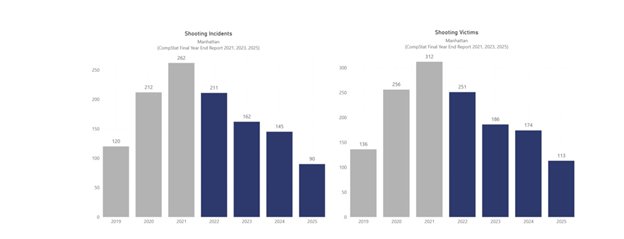
Following a significant increase in crime during the pandemic, New York City has witnessed a gradual improvement in public safety conditions over the past three years. In Manhattan we are proud of the downward trend of serious crime. Manhattan shooting incidents were down 38% in 2025 compared to 2024, 66% compared to 2021, and 25% compared to the pre-pandemic levels of 2019. The number of Manhattan shooting victims also fell below pre-pandemic levels in 2025, down by 35% compared to 2024, 64% compared to 2021, and 17% compared to 2019 pre-pandemic levels, outpacing citywide decreases. We have witnessed this downward trajectory in crime while simultaneously expanding our use of problem-solving courts and screening significantly more people than ever for treatment and programming.
As one part of our enforcement strategy, we participate in an intensive, ongoing collaboration called the Gun Violence Strategic Partnership. Our office sits down five days a week with representatives from every local, state, and federal law enforcement agency in the tri-state area to share information in real time about the most significant drivers of gun violence and gun trafficking. We also cooperate by directing resources towards where we can make the most significant difference.
We have also implemented a unique approach to our gun violence investigations. There has historically been a disparity of resources that are devoted to solving shootings depending on the harm. If someone is shot and killed, law enforcement devotes a lot of time and resources to solve that shooting. If someone is struck by a bullet and survives, there is a significant investigation, but the level of resources is less than a murder. If shots are fired, but no one is struck, investigations occur, but not in the same sustained way as an injury or fatality. The criminal conduct and the danger to the community is significant, but the investigative response differs dramatically, simply due to resource constraints.
Due to a high number of shooting incidents in certain communities, the Manhattan District Attorney’s Office worked together with NYPD and committed resources to investigate every shots-fired incident as if it were a homicide. Following intensive investigations, we secured ten indictments of individuals who we allege were driving the violence in specific NYCHA developments in East Harlem. There is a high likelihood that, absent these proactive investigations, these communities would have experienced additional fatalities and/or non-fatal shootings.
Further, we continue to address the continuing threat that 3D printed guns and gun parts pose on the streets of Manhattan through our Ghost Gun Initiative. Unfortunately, the technology behind 3D printing is only becoming more sophisticated, continuing the threat these weapons pose to our community. We are heartened to see efforts being made on the state level in Governor Hochul’s preliminary executive budget for FY 2027 to make manufacturing 3D-printed guns and gun parts illegal; to stop the sharing, selling, or distributing of files containing blueprints for 3D-printed firearm components; and to require 3D printer manufacturers to take steps to prevent their products from being used to easily produce these cheap yet lethal weapons.
HATE CRIMES
A few years ago, we requested and were granted $1.7 million dollars from City Council to expand our Hate Crimes Unit from two to 15 specially trained prosecutors. We hired new investigators and analysts, and we expanded our community outreach work. The additional funding has also helped the Office’s Survivor Services Bureau hire and retain victim services advocates with cultural competency to assist New York’s diverse communities, including the Jewish, AAPI, Muslim, and LGBTQ communities. We also have a deputy director for the prevention of hate crimes and youth violence who ensures that we are engaging with communities impacted by hate crimes and educating the public about the work of our Office in combatting hate crimes. That funding was crucial to combat the unprecedented rise in hate crimes that we experienced in Manhattan.
For example, our Hate Crimes Unit gave a presentation to emergency room doctors and nurses at Lenox Hill Hospital, so that they are empowered to be credible messengers when they encounter victims and witnesses needing medical attention.
I will also note that in 2024, working alongside state legislative partners and Governor Hochul, we secured a change in the law adding additional offenses to the hate crimes statute. We believe that will help us get some deterrent effect, and reflect more accurately the experiences of victims and survivors in what we can charge.
We’re encouraged that Manhattan reported hate crimes were down 30% in 2025 compared to 2024, and 16% compared to 2021. They are, unfortunately, still up 41% compared to 2019. The work of our Hate Crimes Unit reflects our continued dedication to seeing those numbers continue to fall. In 2025, we brought 105 new hate crime prosecutions, up from 101 in 2024. We will continue to hold hate crime defendants accountable for their conduct, and are committed to providing culturally responsive resources to victims and the various communities experiencing these biased attacks.
Some examples include:
- In May 2025, Jesse Diaz Ramos was sentenced to 25 years in state prison after a jury found him guilty of Attempted Murder in the Second Degree as a Hate Crime and Assault in the First Degree as a Hate Crime, for brutally stabbing a transgender woman after asking her about her sexual orientation and calling her an anti-gay slur.
- In September 2025, Naatiq Giles was indicted for Assault in the Third Degree as a Hate Crime, for—we allege—entering a mosque, interrupting the imam who was actively leading prayers, and pushing him to the ground causing pain and swelling to his He then yelled “you’re not supposed to pray here.”
- In December 2025, Clive Porter was indicted for two counts of Assault in the Second Degree as a Hate Crime, one count of Grand Larceny in the Fourth Degree as a Hate Crime, one count of Assault in the Second Degree, one count of Attempted Assault in the Second Degree as a Hate Crime, and two counts of Attempted Assault in the Second Degree as a Hate crime along with several misdemeanor charges after allegedly committing five separate anti-Asian attacks in Lower Manhattan resulting in several victims being hospitalized for injuries they sustained.
- In February 2026, Skiboky Stora was convicted at trial for two counts of Assault in the Third Degree as a Hate Crime, one count of Stalking in the Third Degree as a Hate Crime, one count of Aggravated Harassment in the Second Degree, and one count of Attempted Assault in the Second Degree for a series of unprovoked attacks driven by anti-woman, anti-white, and antisemitic bias. He is currently awaiting sentence.
RETAIL THEFT
When it comes to retail theft in Manhattan, which is one of the most heavily retail oriented places in the world, we’ve taken a multi-faceted approach, including traditional enforcement, partnership with the private sector, legislative efforts to bolster prosecutions of shoplifters, and increasingly, we’re using our white-collar tools to prosecute those who buy and sell stolen goods.
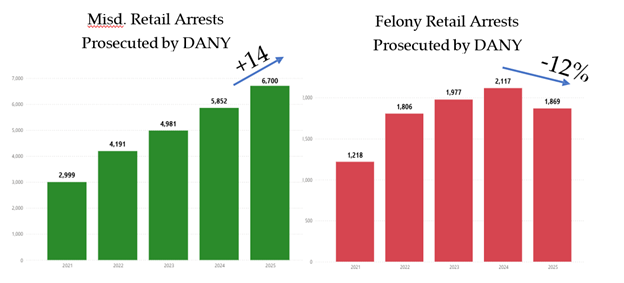
The numbers are heading in the right direction, Manhattan retail theft complaints were down 11% in 2025 compared to 2024, but we have more work to do. Early in my tenure, we created a Manhattan Small Business Alliance bringing together business owners, BIDs, law enforcement and service providers to better understand the problem and target our efforts. We zeroed in on recidivists with a focused deterrence strategy. In 2025, misdemeanor retail prosecutions were up 14% in 2025 compared to 2024 (6,700 vs 5,852 respectively), though felony prosecutions were down 12% in 2025 compared to 2024 (2,117 vs 1,869 respectively), mirroring felony retail arrest trends.
We’re getting people into meaningful treatment for drug and mental health issues through our Pathways to Public Safety Division when appropriate. And in some cases, we are seeking significant incarceration when that is appropriate.
We’re also looking at where all these stolen goods are going and who is profiting from these crimes. From what we have seen, it is the large-scale fencing operation that buys and resells stolen goods from dozens of shoplifters that is really driving that underground economy. We have a case going to trial later this year against Aaron Khan and Bibi Rehana Khan, a brother and sister team who we allege were in possession of more than $1 million dollars in stolen goods that they planned to resell at a physical store as part of their ongoing fencing business. We had another large-scale fencing case underway, but when we brought charges against the brother and sister team, this other group packed up and left town. We see this as deterrence in action, and a win too in terms of drying up demand for stolen goods.
WORKER AND TENANT PROTECTION
In 2023, we launched our Worker Protection Unit to investigate and prosecute wage theft and other forms of worker exploitation across Manhattan. The Unit pursues criminal charges against individuals and corporations that jeopardize their workers’ safety and steal their wages, and protects the city itself from corruption and theft of resources. The Unit also enforces workplace safety labor laws, incorporating the work of the Office’s Construction Fraud Task Force, and pursues criminal charges when an employer creates dangerous or deadly work environments. Building on the Office’s leadership in prosecuting wage theft in the construction and real estate development industries, the Worker Protection Unit expanded the Office’s focus to include other industries with high rates of worker exploitation, such as home healthcare agencies, fast food and restaurants, hotels, and more. We are also coordinating with community groups such as Take Root Justice and Urban Justice Project to ensure workers across Manhattan are aware of their rights as employees and how to reach out to the Worker Protection Unit when appropriate.
The Unit continues to stand up for hard-working New Yorkers as we hold accountable companies that line their pockets at the expense of their employees. In multiple cases recently, we have been able to secure guilty pleas to wage theft charges including restitution payments that are distributed to affected workers. Indictments brought in 2025 alone resulted in nearly $600,000 being returned to 22 workers from the unscrupulous employers who had stolen their hard-earned wages from them. We have also been able to return stolen wages directly to affected workers unable to be made whole via restitution through the Manhattan District Attorney’s Office’s Stolen Wage Fund. The Worker Protection Unit is housed within the Rackets Bureau whose attorneys, in 2025, have also been able to return approximately $1,431,600 to the New York State Insurance Fund through 8 cases prosecuting companies that defrauded the Fund by failing to pay proper workers compensation insurance premiums. Rackets attorneys also returned approximately $150,000 to city and state tax authorities through convictions in three tax fraud cases, and in another conviction we ensured that a first payment of $45,000 was given to the New York City Department of Finance from the more than $700,000 that was determined to be owed and ordered to be repaid by the defendant.
The Worker Protection Unit has also spent much of this year coordinating efforts with other government agencies including a presentation to over 150 employees of the New York State Department of Labor and a forthcoming Memorandum of Understanding with the New York City Department of Consumer and Worker Protection. Our government partners in the NYC School Construction Authority, NYC Department of Investigation, and MTA Inspector General have been critical collaborators for building strong cases against employers engaged in wage theft.
There is no question that stable housing is a cornerstone for public safety, and the housing affordability crisis in New York City is a public safety issue. As housing affordability continues to be a paramount issue to New Yorkers, the Office has also created a Housing and Tenant Protection Unit to ensure that New Yorkers are able to live in their homes without fearing for their safety. This Unit prosecutes landlords who engage in large-scale systemic harassment to push people out of their affordable homes and developers who line their pockets by defrauding government subsidy programs and failing to fulfill their obligations to provide affordable housing.
The range of cases this Unit handles range from abuse of government programs including 421-a tax abatements, tenant harassment, deed fraud, or rental scams. Since its passage, Penal Law Section 241.05 Harassment of a Rent Regulated Tenant in the First Degree has only been charged twice. Both cases were brought by the Manhattan District Attorney’s Office, including an ongoing case against one landlord who is currently indicted with eight charges of Harassment of a Rent Regulated Tenant in the First Degree for allegedly creating dangerous living conditions including no heat or hot water, constant leaks, and broken locks in an effort to push tenants out of their homes across five buildings in Manhattan. We’re encouraged by the number of community members who have come forward and made us aware of activity that threatens their or their neighbors’ ability to stay in their homes. Since the Unit formed, we have received an increasing number of complaints from the community leading to investigations and at times, significant charges. As a result of the reports of these Manhattanites, we have charged nine cases with 32 defendants (17 individuals and 15 corporations), and there are several other ongoing investigations. The cases we have brought include charges for abuse of a government program, namely 421-A affordability; tenant harassment; deed fraud; and rental scams.
TRANSIT CRIME
New Yorkers rely on public transportation. Our transit system must be a safe environment for Manhattanites and visitors alike. Every day, we work closely with our law enforcement partners to hold accountable those who threaten the safety of anyone utilizing our transit system and we will continue to prosecute those who commit acts of violence against commuters, riders, or transit workers. We’re very focused on transit crime because New Yorkers deserve to feel safe taking our subways and buses. Transit crime is down overall, but high-profile incidents are disturbing. Random assaults are especially scary and impact how people feel about taking the subway. The numbers are heading in the right direction. Manhattan transit complaints were down 2% in 2025 compared to 2024, 12% compared to 2022 and 12% compared to 2019. However, transit complaints are up 15% compared to 2021, and we know we have more work to do. Citywide, but particularly in Manhattan, misdemeanor arrests occurring in a transit jurisdiction have accounted for an increasing proportion of all misdemeanor arrests, reaching 17% of all misdemeanor arrests in 2025. We will continue to hold people accountable for acts of transit violence.
In instances of serious violence, we seek and have successfully obtained convictions with serious sentences. At trial we obtained a conviction against Esteban Esonoasue for Assault in the First Degree, a B Felony, and other serious, related charges for an unprovoked Grand Central Terminal attack where he scratched one woman with a fork and stabbed two teenagers with a knife. For this conduct, he was sentenced to 26 1/3 – 29 years in state prison. This past summer, Christian Valdez pled guilty to Attempted Murder in the Second Degree and was sentenced to 18 years in state prison for throwing his girlfriend in front of an oncoming train at the Fulton Street Subway Station, causing serious, life-changing injuries.
However, much of the lower-level disorder and crime we see on the subway is due to the underlying substance abuse or mental health issues. To address this, our Pathways to Public Safety Division attorneys review cases to determine what course of action would best serve public safety, including non-carceral options to address the underlying issues that lead to the arrest.
COMMUNITY PARTNERSHIPS
We know that many of the quality of life issues that are of concern to our communities require an interdisciplinary approach to use all of the available tools in our collective toolbox. In 2022, we were proud to support the creation of the 125th Street Collaborative Hub, led by Barbara Askins of the 125th Street Business Improvement District. We then worked with community leaders and City Hall partners to replicate the model in Midtown (8th Avenue Corridor) and the West Village (Washingtons Square Park). The model includes one to four community leaders know as Co-Chairs, and city agencies, including the Department of Sanitation, Health and Mental Hygiene, Homeless Services, and the NYPD, as well as CBOs providing outreach to the unhoused individuals and those suffering from addiction or mental health issues. The groups meet twice a month, once virtually and once in person in the impacted area. The virtual meeting focuses on concrete issues like scaffolding, sanitation and other issues that impact quality of life and crime. The in-person meeting is focused on outreach to specific people who are unhoused or suffering from mental health and addiction issues.
Focused on addressing a range of public safety issues, including retail theft, substance use, the mental health crisis, and more, the Hub deploys teams to conduct regular walkthroughs to observe issues in real time and speak with local community members and businesses on the ground. They also identify specific individuals in the area who may need connections to services, such as housing or medical care, and make referrals to the appropriate city agency or service provider.
SUPPORTING VICTIMS
2025 marked a significant anniversary for our office – the 50th anniversary of Manhattan’s Survivor Services Bureau (SSB), which was formed in 1975 as the Witness Aid Services Unit. Over that time, both the rights and resources afforded to survivors have expanded significantly. Most recently, the Fair Access to Victim Compensation Act eliminated certain barriers and provided more time for victims to seek compensation. All these changes can be credited to the persistent advocacy of crime survivors and their supporters, whose accomplishments cannot be overstated.
The transformation of survivor services in the Manhattan D.A.’s Office over the decades has been similarly extraordinary. What began as a unit of fewer that ten people, focused primarily on obtaining corroborating statements and securing orders of protection has grown into a bureau of almost 50 professional staff who provide notification services, case management, advocacy, counseling, and more.
Since the unit was revamped and expanded into the Survivor Services Bureau, we have been able to use the funding previously provided by City Council to increase staffing and innovate the bureau’s procedures. Two years ago, we adopted an automated management tool to connect SSB staff with survivors as early as possible. This system now covers all domestic violence cases. And we increased our crisis responses by 280% over two years; in 2025, 7,863 domestic violence survivors involved in 7,707 DV cases were referred to SSB, and the advocates and counselors conducted 1,845 intakes with those survivors.
Our expanded Survivor Services Bureau is core to our public safety strategy. By providing trauma-informed support to survivors, we strengthen community trust in our office – trust that we rely on to bring cases and keep Manhattan safe. And by ameliorating the trauma of crime victims and witnesses before it metastasizes, we prevent untreated trauma from fueling further violence.
NEW ASKS
The Manhattan District Attorney’s Office and I are sincerely grateful to the City Council for its continued support. Through this body we have been able to create new Units, expand critical survivor services, and best protect public safety through fairness and justice. With money that was allocated to our office last year, we have been able to increase our headcount and fill a significant number of open positions. In the upcoming year we are looking to further increase our legal staff across several divisions in our efforts to process cases more quickly and safely from arrest to disposition.
INCREASED LEGAL STAFF FOR THE SPECIAL VICTIMS DIVISION
Domestic violence is among the most common crimes in New York City and the nation, and yet, it is also widely misunderstood, and therefore, under-reported. When I took office, I created the Special Victims Division (SVD), within which our Intimate Partner and Sexual Violence (IPSV) Bureau is housed handling these types of cases. The total number of cases handled and resolved within SVD has sharply risen since the creation of the division in 2022, with approximately 300 cases resolved in 2022 and nearly 6,000 resolved in 2025.
In New York City, domestic violence comprises about 40% of all felony crimes. In Manhattan, about 13% of the cases we resolved last year were intimate partner violence cases. As of March 12, 2026, we had more than 1,600 IPV cases pending, including about 500 felony IPV cases. And it’s important to note that those are just the cases that get reported. We know that there are many more victims who do not report these crimes to law enforcement. So, we want to do everything we can, in partnership with local elected officials, community-based organizations, and city agencies to encourage victims to seek help.
One strategy to prevent intimate partner felony assaults is to identify lower-level IPV offenses that could signal a high risk of escalation to more serious violence, and then to respond to those high-risk situations with urgency and appropriate resources through what we call Early Engagement. An Early Engagement Team consists of prosecutors, analysts, investigators, and victim advocates who work closely with the NYPD to review domestic incident reports and complaints even before there is an arrest. The Team then works to connect with the survivor and provide support and resources, and together with the NYPD investigate the case and collect and preserve evidence as soon as possible. This enhances the cases, reduces the likelihood of case dismissals, and allows us to hold more abusers accountable.
Our IPSV Bureau has full time specialized prosecutors assigned to our most serious IPV cases. These ADAs are extensively trained in trauma and survivor informed practices. Also, our Survivor Services Bureau provides free, high-quality counseling, safety planning and other services, regardless of whether a survivor wants to participate in a criminal prosecution. Our focus is on survivors and what they need to be safe. Domestic violence is one of the most persistent and intractable public safety challenges facing communities across the nation. But here in New York City, we continue to innovate. We continue to invest more resources. And we continue to forge strong partnerships across law enforcement, government agencies, and community-based organizations to hold abusers accountable and provide survivors the safety and support they deserve.
I’d like to focus on the full-time specialized prosecutors assigned to the IPSV bureau. A key piece of our model for these cases is ensuring that our ADAs are not only trained to handle a criminal prosecution, but to be able to work with survivors in the most empathetic and effective way. This means having the legal expertise to handle these complex cases, but also requires understanding and responding to the trauma faced by the survivors in these cases. These increased demands and sensitivities require additional time and resources that must be spent on each case by our IPSV attorneys. Every week since January 1 of this year, we have had an average of 30 felony cases coming into the bureau, meaning that once a week we are filling the ideal caseload of a single IPSV prosecutor.
Coupling the continually increasing caseload with the additional time and attention an attorney must spend on each of these cases, along with our core casework, will require us to add more attorneys and more legal managers to oversee this larger legal staff. We are asking for $3,900,000 to hire twenty (20) more Assistant District Attorneys and five (5) supervisors.
INCREASED LEGAL STAFF FOR THE PATHWAYS TO PUBLIC SAFETY DIVISION
The Pathways to Public Safety Division handles all our felony problem-solving court cases, as well as misdemeanor cases where services are deemed to be appropriate. Our specially trained Pathways Deputies screen every felony case with one key question in mind: what is going to make us safer? In many serious, violent cases, the answer is that incarceration is necessary to protect public safety. In those instances, we use our traditional tools to pursue accountability. Other times, it is clear that the best path to keep the community safe is to offer rigorous, court-monitored services to address underlying issues like substance use disorder, mental illness, joblessness, housing instability, and trauma. Not only are these common drivers of recidivism; they also make people more vulnerable to becoming victims of crime.
We are immensely proud of this work done by our Pathways to Public Safety Division in evaluating eligible individuals to divert away from the traditional trial courtrooms into problem-solving courts. The Manhattan DA’s Office has been at the forefront of problem-solving courts in New York. There are currently four such felony courts in Manhattan, and we are continuing to advocate for further expansion. DANY funded the first six years of the Felony ATI Court (a first-of-its-kind court that has no charge or need-based criteria) and the first several years of the specialized Mental Health Track within Manhattan’s Article 216 Judicial Diversion Drug Court. The Office of Court Administration took over these multi-million dollar investments in April 2025. Additionally, Pathways worked with the Office of Court Administration to launch a Misdemeanor Alternative to Incarceration Compliance Court Part overseen by Pathways ADAs and case coordinators, and we staff Midtown Community Justice Center several days a week. In total, Pathways staffs 44 court parts each month.
Pathways prosecutors proactively screen all Trial Division and Special Victims Division felony cases within 48 hours, and review thousands of misdemeanor cases each year. Cases considered for Pathways are reviewed individually and holistically in conjunction with independent clinical records. With the creation of Pathways, DANY has more than doubled felony problem-solving court referrals; close to one-quarter of indicted felony cases in Manhattan sit in one of the four felony problem-solving courts and many more are in other courts while they are reviewed. Our record of success is clear. Based on encouraging data indicating distinctly low recidivism rates of participants that graduate from problem-solving courts, we are making Manhattan safer.
Since this Division was created in 2022, we have almost halved the time from arrest to treatment disposition for felony cases. However, our expansion efforts have been challenged by the fact that all four courts are currently at or over maximum capacity. The courts, stakeholders, and community-based providers are under-resourced and struggle to provide individualized attention and supervision in line with research-backed best practices. Wait times for clinical assessments and connection to services remain significant. To expand access and improve outcomes, Pathways has already started the process of advocating for another felony problem-solving court. We also need to add additional legal staff to this division to allow for quicker processing of these cases once a defendant with appropriate needs is identified, and also to further assist the city with its goals of reducing the jail population on Rikers Island by more swiftly moving those defendants to the appropriate programs. We are asking for $2,900,000 to hire twenty (20) more Assistant District Attorneys.
And while it is not a funding request specifically for the Office, ATI programming is critical to the success of our Pathways Division and to public safety more broadly. We urge the Council to fully fund these programs.
NEIGHBORHOOD NAVIGATORS
The Manhattan District Attorney’s Office made a $5.6 million, three-and-a-half-year investment (August 2023 through January 2027), to launch and operate a Neighborhood Navigator Initiative to address community concerns in four high needs areas in Manhattan: Inwood and Washington Heights, Central and East Harlem, Chelsea/Hell’s Kitchen/Midtown West, and the Lower East Side and Chinatown. Operated by The Bridge, a non-profit in Harlem, the Initiative is a trauma-informed, recovery-oriented model that employs peer navigators with lived and shared experiences. The navigators work to build trust with people, offering them care rooted in empathy, and often start their connection by offering a warm cup of coffee, a meal, or a conversation. They engage in direct outreach to potential partners and host regularly scheduled stakeholder meetings to build interest, receive referrals, and respond to urgent community needs. The Initiative launched in February 2024, and as of October 31, 2025, the Neighborhood Navigators have engaged with 2,685 individuals, secured housing placements for 94 people, created ongoing client relationships with 46 individuals, and provided over 1,500 individuals with resources and referrals.
While limited to a handful of neighborhoods in Manhattan, data has shown promising results. Individuals, many with significant needs, have received both immediate resources and more formal long-term services and supports. Nearly one hundred individuals have been assisted in securing housing. Seeing the incoming administration championing this type of community-based approach to meeting the needs of currently unserved neighbors and the recently introduced legislation to create a Department of Community Safety sponsored by more than half of this Council is encouraging, and we look forward to seeing this model expanded throughout Manhattan and the entire city. To keep this program running in Manhattan will cost $2,500,000 per year.
COURT BASED NAVIGATORS
We have also invested $3 million in a similar initiative, Court-Based Navigators, for individuals leaving arraignments, developed in partnership with the Fortune Society. Court-based navigators ensure that people leave the courthouse with the immediate support they need to avoid future arrest and further system involvement. Navigators draw from lived experiences with justice involvement, homelessness, or behavioral health challenges, enabling them to build rapport quickly and authentically. Navigators offer immediate resources such as food, clothing, hygiene items, OMNI cards, and escorts to housing or treatment programs. They also conduct needs assessments and initiate short- and long-term referrals to Fortune programs and community partners. Engagement continues beyond the courthouse when navigators follow up with participants, schedule appointments, make warm handoffs to providers, and help people navigate their longer-term goals. From August 2024 through October 2025, our court-based navigators have engaged with 1,654 individuals, secured housing placements for 58 people, created ongoing client relationships with 76 individuals, and provided hundreds of resources and referrals. By facilitating immediate voluntary connections to resources post-arraignment, we help ensure that individuals are returning to the community with the immediate support they need and opportunity to connect with longer-term support to avoid further involvement in the criminal justice system.
While the current Court-Based Navigator program uses peers with lived experience related to justice involvement and behavioral health needs, specialized peers could engage and connect with individuals in other court parts, including misdemeanor and felony problem-solving courts and specialized parts designed to address intimate partner violence, gun possession, and emerging adults (18-25-year-olds). By staffing each setting with peers who bring both relevant lived experience and specialized training tied to the court’s focus, this model can offer tailored, trauma-informed support, ensuring every court room is resourced to offer support and immediate connection. The continued success of this navigator program will cost $2,000,000 per year.
###